Review: Life After Cars
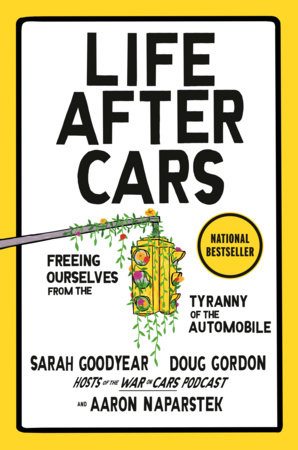
Life After Cars is a well-argued tour through the rise, costs and alternatives of car society. The book delivers strong arguments and concrete examples, but it’s deeply rooted in an American context, where car dependency is so extreme that European readers sometimes have to work a little to translate the reasoning into their own everyday lives.
For those of us already convinced of the need for car-free cities, it may be no eye-opener. But it’s excellent whetstone material. Here is ammunition for the debate, well-packed and accessible.
What surprised us
One of the book’s most surprising parts is about how strong the resistance to the car actually was in its infancy, and how decisive the motor lobby was in winning that fight. It’s a reminder that car society wasn’t inevitable. It was an active choice, driven by strong commercial interests, not least by Henry Ford himself. A figure as driven as he was deeply problematic, whose antisemitism the book doesn’t shy away from.
Sound and chemistry: the hidden violence
The book is unusually good at highlighting the car’s more invisible harms. Noise, for example. Once you’ve read those sections, it’s hard to stop hearing the constant roar of traffic and realizing how normalized it has become. The same goes for wildlife: how roads fragment habitats, block movement between them and drive inbreeding in isolated populations.
The sections on chemical emissions are sober and important. The electric car is presented for what it is: a band-aid on a deeper wound. It solves certain emission problems but doesn’t address noise, land consumption or the social cost the car norm imposes.
Parking, the invisible elephant
On average, a car sits parked over 95 percent of its life. That space isn’t a natural state, it’s an active subsidy of one mode of transport at the expense of everything else: housing, green space, sidewalks, squares.
One of the book’s more thought-provoking sections is about exactly that. Free or cheap parking seems like a given, but it’s a political choice. Once you see it, it’s hard to stop counting parking spaces.
Beyond the car: concrete examples from around the world
What makes the book worth reading is that it doesn’t stop at the problems. It’s full of examples of what actually works, and often the solutions are neither expensive nor technically advanced.
Bike buses, where parents take turns leading groups of children to school by bike, have spread from Spain to the US and proven to be a simple way to reclaim the street, increase safety and cut the school run. Around the world, citizen groups have used simple means, planters, chairs and temporary plantings, to turn parking areas into meeting places, often with no permit beyond courage and a free Saturday.
It isn’t always about big political decisions. Sometimes it’s enough for a handful of neighbors to decide.
Closing words
The book’s real message isn’t which vehicle we should switch to, but that we need to renegotiate the whole logic of the city. Denser building, public transit, walkable environments and the bike as one of several options. The solutions are neither new nor secret. It’s about priorities, and about which interests we let shape our cities.
Recommended, especially for those who want to sharpen their arguments for the next conversation with a car advocate.
Read next
The Dark Side of Data and Conclusion
The last part of the summer street series takes a critical look at the Gatupotential report's numbers, with Malmskillnadsgatan as the oddball, and sums up what makes a summer street work. A guest post by Irena Toljan on overhyped data with holes.
9 min readThe Rest: Summer Streets with Untapped Potential
Not every summer street in Stockholm is a roaring success. A guest post by Irena Toljan on five summer streets that fall short, from Nybrogatan's traffic chaos to a deserted Kista torg, and what could fix them.
8 min readCentralvägen (Solna)
Centralvägen in Solna closed one side of the road for the summer and became a meeting place with play areas, outdoor dining and World Cup screenings. A guest post by Irena Toljan on why this suburban summer street wins in her book, and what it got wrong with bike parking.
4 min read